
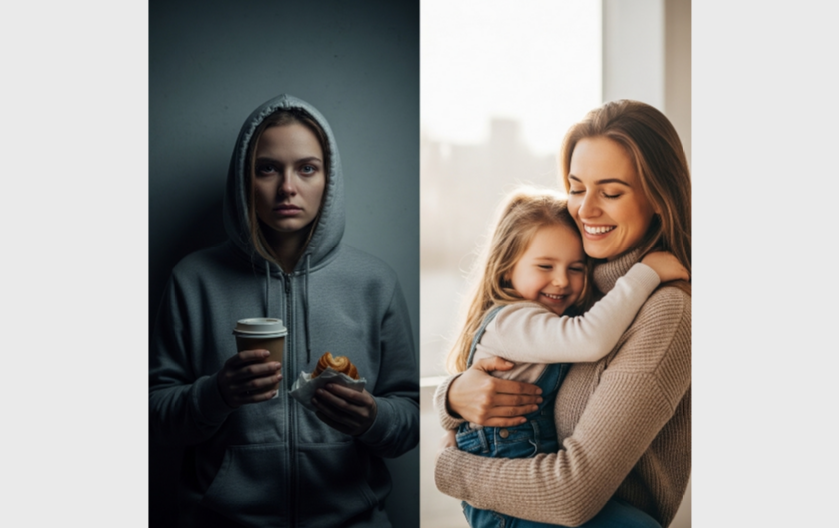
I thought the worst thing my parents had done to me was the night they kicked me out of the house at nineteen, pregnant. I was wrong. The worst thing was finding out that the life they built afterward depended on secrets I was never supposed to discover.
I was twenty-six years old when everything came full circle.
Seven years earlier, my parents kicked me out onto the street.
I was 19, six months pregnant, and standing outside our Connecticut estate with three garbage bags and a dead phone. My mother stood under the dry, immaculate front arch and said to me, “You’re a stain on this family.”
I never went back. Not once.
Then he looked at my stomach and added, “If you ever come back, I’ll make sure that child disappears from your life.”
My father didn’t stop her. He simply said, “You’ve made your decision.”
The doors closed behind me.
I never went back. Not once.
I had three jobs. I cleaned offices at night. I worked as a receptionist on weekends. I took online classes while Elia slept beside me. I learned to stretch my soup, to smile at landlords who saw me as a risk, to keep going when my body wanted to give up.
Then, a month ago, I received a package.
Elia is six years old now. She has my eyes and a laugh that makes strangers smile. She’s the best thing to come out of the worst night of my life.
I received a package a month ago.
Inside there was a note.
“You deserve to know the truth.”
Underneath was a birth certificate.
There was one more thing in the envelope.
My mother’s name.
A son.
Older than me by four years.
My mother had another son. A son she never spoke to me about. A son she had also abandoned.
There was one more thing in the envelope. A sticky note with a name, a city, and two words.
“He survived.”
His name was Adrian.
He called that night.
Finding him was easier than it should have been, because he wasn’t hiding. He owned hotels, investment firms, and half the things people write profiles about in fashion magazines. I emailed him. Short. Careful. I attached his birth certificate.
He called that night.
He didn’t greet me. Just: “Where did you get this?”
“From someone who worked in our house.”
Silence.
More silence. I could hear him breathing.
Then: “Our house?”
“My mother is your mother.”
More silence. I could hear him breathing.
Finally, he said, “I always suspected it. I never had proof.”
“So it’s true?”
“Yes.” She paused. “They told me it was best if they forgot about me.”
We met three days later in a quiet restaurant.
I closed my eyes.
He asked me, “How old are you?”
“Twenty-six.”
He let out a bitter laugh. “He replaced me quickly.”
That was our beginning.
We met three days later at a quiet restaurant halfway between our destinations. He came in wearing a dark coat and with the expression of a man used to being obeyed. Then he saw me and stopped.
He asked me about my life.
He looked me in the face for a second and said, “You have her cheekbones.”
“I was going to say you have your dad’s mouth.”
She sat down. “I don’t know if that’s an insult.”
“It is”.
That made him smile.
He asked me about my life. I told him. Then he asked, “How did they kick you out?”
We started investigating because we wanted answers.
So I told him the ugly version.
When I finished, he remained silent for a while.
Then he said, “When I was ten years old, I asked why no one ever visited me on my birthday. The woman who raised me said, ‘Some people only love what they can show off.’ I didn’t understand it then.”
“Now we’re talking,” I said.
We started investigating because we wanted answers. At first, that was the truth. Not revenge. We wanted to know what kind of people erase their own children and then continue to organize charity galas with a straight face.
Payments made to keep the shame hidden.
A former housekeeper met us in a church parking lot and gave us copies of letters she had kept for years.
Family members disinherited after divorces.
A cousin had his alimony withdrawn after rehabilitation.
A widowed aunt was evicted from the farm’s house because she “lowered her voice.”
Payments made to keep the shame hidden.
Old trust summaries.
Later, when she went to bed, he remained very still.
Staff notes.
Adrian read it all at my kitchen table while Elia colored next to us.
He looked up and asked, “Are you my uncle?”
She blinked. “I think so.”
She nodded. “Okay. Do you want the purple pencil?”
He took it. “Thank you.”
It was a fiduciary clause added by our grandfather.
Later, when she went to bed, he remained very still and said, “No one has ever given me a purple colored pencil before.”
I leaned against the sink. “Welcome to the family.”
A week later, he called and said, “I’ve found something.”
It was a fiduciary clause added by our grandfather.
If the two biological heirs came forward together with evidence that they had been unfairly expelled for reasons of reputation or image management, control of the family foundation and certain legacy assets would be transferred from the parents to the heirs.
“Did they know this could happen?”
I read it three times.
Then I said, “This has to be a joke.”
“I had it double-checked.”
“Did they know this could happen?”
“I think our grandfather knew exactly who they were.”
We just sat there with that.
A few days later, we saw an advertisement for a private event at his club.
Then I asked, “What do we do?”
Adrian replied, “What do you want to do?”
I thought about the rain. The garbage bags. My mother’s voice. Elia asleep in the next room.
“I want it to end,” I said. “Not just for us. For everyone, who was treated like an accessory.”
He replied, “Well, we’ll finish it properly.”
A few days later, we saw an announcement for a private event at her club. Donors. Trustees. Old family friends. My mother was to be honored for “a lifetime of grace and service.”
On the night of the event, I almost backed out in the parking lot.
I showed Adrian the post on my phone.
He told me, “That wording is almost insulting.”
“Let’s do it?”
“Yeah”.
On the night of the event, I almost backed out in the parking lot.
Adrian was adjusting his fists as if he were about to walk into a board meeting.
I laughed once. It was just a small laugh.
I told him, “My hands are shaking.”
She looked at me. “Mine too.”
“It’s not noticeable.”
“I’m more practiced at hiding it.”
I laughed once. It was just a small laugh.
He moved a little closer. “Listen to me. We’re not children asking to be let back in. We came in with the truth.”
We went straight to their table.
Inside, the club was exactly as I remembered it. White columns. Polished silver. Soft voices.
My parents were near the central table. My mother, dressed in pale silk. My father, in a black tie, smiling as if the room belonged to him.
For a second, I was 19 again.
Then Adrian said, “Stay with me.”
We walked straight to their table.
People noticed. The conversations died down. My mother was the first to look up. She saw me and froze. Then she saw Adrian.
Adrian placed a sealed document on the table.
I saw the blood drain from his face.
My father stood up. “What is this?”
Adrian placed a sealed document on the table. “Your past arriving on time.”
My mother whispered, “No.”
I placed the second folder next to it. “Open it.”
My father’s voice sharpened. “You’re making a scene.”
My father grabbed the papers.
I looked at him. “You should be grateful. You taught me the value of opportunity.”
My mother’s fingers trembled as she broke the seal. She read the first page and sat down heavily.
Then she whispered, “I knew this day would come… but not like this.”
Adrian’s voice was calm. “Neither have we. We haven’t come to ruin you. We’ve come to put an end to this family’s version of themselves, a family that only cared about appearances.”
My father grabbed the papers. Adrian stopped him.
My mother looked at me as if she wanted to erase me instantly.
“What is this nonsense?” he exclaimed.
Adrian faced the table, then the room. “A fiduciary clause created by our grandfather. It transfers control of the family foundation and designated bequest properties if both heirs prove they were unfairly disinherited to protect the family’s image.”
Someone close to the family said, “Both heirs?”
I replied: “Yes, both.”
My mother looked at me as if she wanted to erase me instantly.
Adrian opened the file and read the clause.
Instead, he said, “This is private.”
I said, “It stopped being private when you built your reputation by pretending we didn’t exist.”
My father let out a short, ugly laugh. “Do you think you can just barge in here and take what we’ve built?”
Adrian opened the file and read the clause, the dates, the signatures, the verification. Then he began to name the pattern we had found.
“Support revoked for relatives who brought shame to the family.”
A card on the table.
The room fell silent.
“House taken away from a widowed aunt after guests complained about it.”
Other.
“Education funding threatened when a cousin dated someone deemed unsuitable.”
Other.
“Staff fired for showing kindness to the wrong people.”
The room fell silent.
Their perfect marriage began to crumble in public.
Mom got up too quickly. “I did what was necessary to protect this family.”
I told him, “No. You protected a performance. You called it family because it sounded better.”
My father turned on her. “Don’t say another word.”
She said, “Why? You were happy enough when it benefited you.”
Their perfect marriage began to crumble in public.
At the edge of the room, I saw the staff standing motionless with trays in their hands. Some had known me since I was a child. An older woman looked as though she had been waiting for this for years.
Adrian stood next to me.
I moved away from my parents and faced the room.
“Do you know what the real problem is?” I said. “You all know the names of the wines, the donors, and the horse breeds. But half the people here couldn’t tell you the names of the people who keep this place running.”
Nobody moved.
Adrian stood beside me. “Our first act as incoming co-chairs will be a complete review of staff treatment, retirement benefits, housing allowances, and education grants linked to the estate and foundation.”
Then I heard a small voice behind me.
Mom looked at me intently and said in a low voice, “After all, would you still take everything from me?”
I laughed once. “You threw your pregnant daughter into the rain and threatened my daughter. Don’t talk to me about loss.”
She shuddered.
Then I heard a small voice behind me.
“Mother?”
I turned around quickly.
“Are you okay, Mom?”
Elia was standing there with our car seat nanny. Big eyes. Pink shoes. Confused, but not scared.
I knelt down. “Hello, darling.”
“Are you okay, Mom?”
I put my hands on his shoulders. “Yes. I am now.”
He looked around the room full of frozen adults. “Why is everyone acting so weird?”
Adrian knelt beside us. Elia looked at him and asked, “Should we keep using purple?”
We met with the staff one by one.
He smiled. “Always.”
Then he stood up and said, loud enough for the room to hear, “This is what family is now.”
The following week brought calls, statements, and board reviews. People who had ignored me for years suddenly wanted my perspective.
I ignored most of them.
Adrian and I took control of the foundation. Not as victors. As people cleaning up a poisoned house.
We met with the staff one by one. We learned their names. We listened. We thanked the former housekeeper who sent the package. She cried. I cried too.
Elia took my hand and looked at the house.
We restructured the foundation around things my parents would have considered shameful: housing assistance for single mothers, scholarships for workers’ children, emergency aid for women without family income, and prenatal care assistance.
Practical things. Human things.
Months later, we held a small event on the estate grounds. No orchestra. No press line. Just families, food, and children running around on the grass.
Elia took my hand and looked towards the house.
I squeezed his hand.
Then he asked, “Why are people smiling at us?”
I looked at the doors in the distance. The same ones that closed behind me years ago.
Then I looked at my daughter.
“Because this place used to belong to people who thought that love had to be earned.”
She paused, lost in thought. “What now?”
Then he ran off across the grass, laughing.
I squeezed his hand.
“Now it belongs to people who know more.”
Then he ran off across the grass, laughing.
And this time, no doors closed behind us.